Why the Store You Shop In Shapes the Clothes You Actually Reach For
Most of us have been there: a closet stuffed to capacity, and yet somehow nothing to wear. It's one of the most universally relatable frustrations in modern life, and it has very little to do with how many pieces you own. What it actually has to do with — according to behavioral researchers, stylists, and a growing body of consumer psychology data — is how those pieces were acquired in the first place.
The shopping environment shapes your wardrobe more than you might expect. And the difference between a boutique and a big-box store isn't just aesthetic. It's psychological, practical, and surprisingly personal.
The Paradox of Too Many Options
In 2000, psychologists Sheena Iyengar and Mark Lepper published what became one of the most cited studies in consumer behavior research: the jam study. Shoppers presented with 24 varieties of jam were far less likely to make a purchase than those shown just six. More options, counterintuitively, led to less satisfaction and less action.
Fashion retail is living proof of this paradox at scale. Walk into a major department store or fast fashion chain and you're navigating thousands of SKUs, trend cycles that refresh every few weeks, and a sheer volume of product designed to overwhelm. The result? Decision fatigue. You grab something that seems fine in the moment, get it home, and it never quite fits into your actual life.
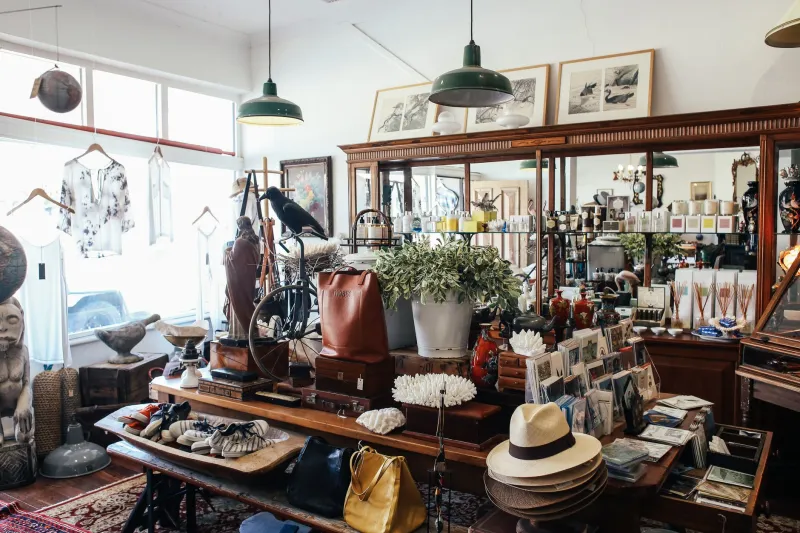
Boutique retail operates on an entirely different logic. A tightly curated selection — say, 40 pieces instead of 4,000 — forces a different kind of attention. Every item on the floor had to earn its spot. That curation isn't just a business decision; it's a service to the shopper.
What Curation Actually Does to Your Brain
When a boutique buyer selects a piece, they're doing cognitive work on your behalf. They've already filtered out the noise, evaluated quality, considered how the piece might work across different body types and lifestyles, and made a judgment call about its staying power beyond this season.
For the shopper, that pre-filtering has a measurable effect. Research on decision-making consistently shows that when we trust the context in which a choice is presented, we feel more confident in the choice itself. A boutique environment signals: someone already thought about this carefully. That signal reduces anxiety and increases the likelihood that you'll feel good about what you bring home.
Stylists who work with clients across both retail environments report a consistent pattern. "When clients come to me with pieces from boutiques versus mass-market stores, the boutique pieces almost always have a story attached to them," says one New York-based personal stylist who works with clients across price points. "They remember why they bought it. They can tell you exactly what they planned to wear it with. That intentionality translates directly into wearing frequency."
The Numbers Behind the 'Cost Per Wear' Argument
Fashion sustainability researchers have been tracking wearing frequency for years, and the data is pretty striking. Studies consistently find that the average American wears a garment fewer than ten times before it's discarded or donated. Fast fashion items — bought impulsively, often at low price points — skew that number even lower.
Boutique purchases, by contrast, tend to be worn significantly more often. Part of that is price point: when you spend more on something, you're more motivated to justify it. But a larger part is the intentionality baked into the purchase. Boutique shoppers typically have a clearer sense of why they're buying something, which means it integrates more naturally into their existing wardrobe.
This is what fashion insiders call the "cost per wear" calculation — and it almost always favors the more considered purchase over the cheaper impulse buy. A $180 blouse worn 40 times costs $4.50 per wear. A $35 top worn twice costs $17.50 per wear. The math is uncomfortable but real.
The Personalization Factor
There's another layer to this that pure economics can't fully capture: the experience of being seen as an individual.
In a mass-market retail environment, you're essentially anonymous. The store isn't designed around your specific body, your lifestyle, your aesthetic history. It's designed around a demographic average — which means it fits almost no one perfectly.
Boutique shopping, at its best, inverts that dynamic. Staff who know their inventory deeply can make connections that no algorithm can replicate. They notice that you always gravitate toward structured silhouettes. They remember that you mentioned you needed something for a specific kind of occasion. They pull a piece from the back that wasn't even on the floor yet because it reminded them of you.
That personalization has real downstream effects. When a piece was chosen for you — even partially — you wear it differently. You feel more confident in it. It feels less like something you found and more like something that belongs in your life.
Why Your Closet Reflects Your Shopping Environment
Open the closets of two people with similar budgets and similar general aesthetics, and you'll often be able to tell almost immediately which one shops primarily at boutiques and which one shops primarily at big-box retailers.
The boutique closet tends to be smaller in volume but higher in coherence. Pieces relate to each other. There's a discernible point of view. Even if it's not perfectly organized, it feels considered.
The big-box closet, by contrast, often has more sheer quantity — but less clarity. There are pieces that were clearly impulse purchases, things that seemed exciting on the hanger but never quite worked in practice, duplicates of items bought because the first version was forgotten. It's not a reflection of personal style so much as a record of shopping sessions.
None of this is a judgment about spending habits or income. It's about the relationship between the shopping environment and the wardrobe it produces. Intentional retail produces intentional closets. And intentional closets produce more confident, more satisfying daily dressing.
Shopping Small as a Style Practice
The shift toward boutique shopping isn't just about rejecting fast fashion or supporting small businesses (though both are genuinely meaningful reasons). It's about recognizing that where you shop is part of your style practice — not separate from it.
Every time you walk into a well-curated boutique, you're participating in a different kind of conversation about clothes. One where quality matters more than quantity. Where the person helping you actually knows the product. Where the selection itself is a form of editorial — a point of view made tangible in fabric and form.
That conversation changes what you bring home. And what you bring home changes how you get dressed every morning. Which, quietly and cumulatively, changes how you move through your day.
That's the boutique effect. It's not magic. It's just what happens when shopping becomes intentional.