Ditch the List: Why the Best Thing You Ever Bought Wasn't on Your Radar

Let's be honest about the wishlist. You build it with the best intentions — a running catalog of things you've researched, considered, compared, and deemed worth pursuing. It feels responsible. Intentional. Like the mature, non-impulsive way to shop.
And then you buy something off it and feel... fine. It fits the way you expected. It looks the way the photos suggested. It does exactly what you thought it would do. And somehow, despite all that, it never quite becomes a favorite.
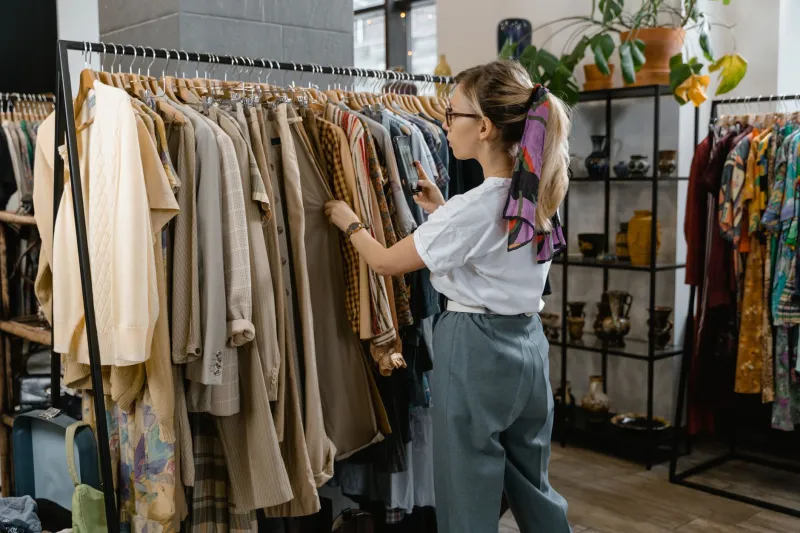
Meanwhile, the rust-colored blouse you grabbed at a boutique on a Saturday afternoon you weren't even planning to shop has become the thing you wear on every first impression occasion. Go figure.
The Problem With Shopping for Something Specific
When you go looking for a particular item, you've already made a lot of decisions before you've tried anything on. You've decided on a category, a general aesthetic, probably a color range. You've looked at enough options online that you have a mental image of what you're after. And when you finally find something that matches that image, you buy it.
The problem is that the mental image you built over three weeks of browsing is based on what you've already seen — not on what might actually be out there. You've essentially been shopping inside your own imagination, and your imagination is limited by your existing taste.
The wishlist, for all its organizational appeal, keeps you inside a loop.
Discovery Works Differently
When you walk into a boutique without an agenda, something different happens in your brain. You're not matching items against a predetermined template. You're just looking — openly, without the filtering that comes with a specific search.
In that state, you notice things you'd have scrolled past online. The unexpected texture. The color that shouldn't appeal to you but somehow does in person. The silhouette you'd never have clicked on in a thumbnail but that, on an actual hanger in actual light, makes immediate sense.
This is the psychology of discovery, and it's genuinely different from the psychology of acquisition. One is about finding what you already want. The other is about finding out what you didn't know you wanted. The second one tends to produce more interesting results.
Context Changes Everything
Here's something the wishlist can't replicate: the moment of in-person context. When a boutique associate pulls something for you — not because you asked, but because they thought of you when it came in — they're adding layers of meaning that no algorithm can match.
They might say "this would be perfect with those wide-leg trousers you got here last spring." And suddenly you're not just looking at a new piece in isolation. You're seeing it in relationship to your actual wardrobe, your actual life. That context collapses the distance between "interesting item" and "thing I genuinely need."
The wishlist item, by contrast, exists in a vacuum. You know you want a camel coat in the abstract. But do you know exactly where it fits, what it completes, what it makes possible? Usually not — not until it's already home and either clicking into place or quietly failing to earn its keep.
Why Unplanned Finds Become Wardrobe Staples
There's a reason the spontaneous purchase so often outperforms the researched one, and it comes down to a simple distinction: emotional resonance versus rational justification.
When you buy something off a wishlist, you've talked yourself into it. You've made a case. You've decided it makes sense. That's a cognitive process, and it's reasonably good at identifying things that are correct — but not always great at identifying things that are right.
When you buy something in the moment, in a boutique, because it made you feel something when you put it on — that's a different kind of knowing. It's immediate and physical and harder to articulate, but it tends to be accurate. The things we reach for again and again are almost never the things we decided we should want. They're the things that got us before we had time to think.
A New Way to Think About Impulse
None of this is an argument for reckless shopping. Buying things you can't afford or don't genuinely need is its own kind of problem, regardless of whether it was planned or spontaneous.
But there's a difference between reckless impulse and informed spontaneity. When you're shopping at a boutique where the curation is thoughtful and the staff knows your taste, an unplanned purchase isn't really a shot in the dark. It's a recommendation from a trusted source, tried on in person, experienced in real time. That's actually a pretty rigorous process — just a faster one than the wishlist suggests.
So the next time you walk into a boutique without a list and walk out with something you didn't expect to find, don't second-guess it. Your gut got there before your spreadsheet did. And in matters of personal style, that's usually the smarter arrival.