Your Brain on Boutique: The Science Behind Why In-Person Shopping Feels So Different

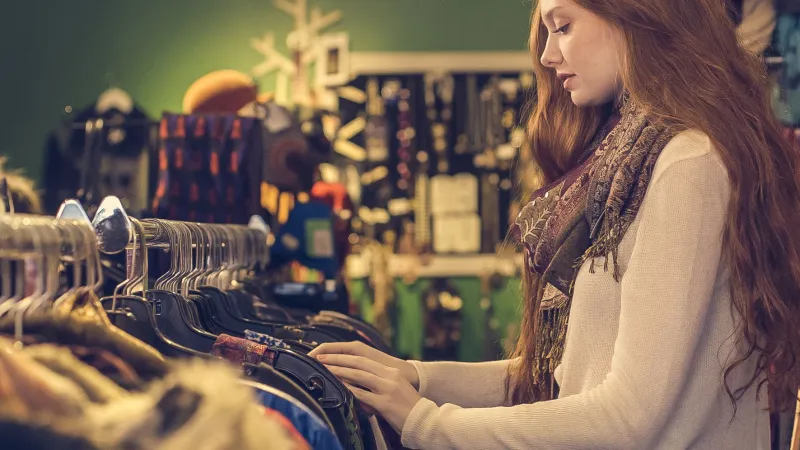
You walk into a boutique. The lighting is warm. Something smells faintly like cedar and fresh cotton. A rack of linen blazers catches your eye, and before you've even consciously decided to move toward it, your hand is already reaching out to feel the fabric. Twenty minutes later, you leave with a dress you weren't expecting to find — and somehow, you feel genuinely good about it.
Now compare that to the last time you spent forty-five minutes scrolling through an online retailer. You added things to your cart. You removed them. You closed the tab. You can barely remember what you looked at.
This isn't just a mood difference. It's a brain difference. And the gap between how your mind processes in-person boutique shopping versus digital browsing is bigger than most people realize.
Touch Is the Original Shortcut to Memory
Here's something worth knowing: your brain has a dedicated system for processing tactile information, and it's deeply wired to your emotional and memory centers. When you reach out and feel a fabric — the weight of a cashmere sweater, the slight texture of a woven jacket, the cool smoothness of silk — your somatosensory cortex lights up. That sensory data gets routed almost immediately to the hippocampus, which is your brain's memory consolidation hub, and to the amygdala, which handles emotional response.
In plain terms: touching something helps you remember it, and that memory comes attached to a feeling.
This is why researchers studying consumer behavior consistently find that people who physically handle a product before purchasing it report higher satisfaction with that purchase afterward. The act of touch creates what psychologists call "psychological ownership" — a sense that something already belongs to you, even before you've bought it. Online, you get images. In a boutique, you get that.
The Mirror Moment Is More Powerful Than It Looks
There's a specific thing that happens when you step in front of a fitting room mirror that no amount of "AR try-on" technology has managed to fully replicate. You're not just seeing how something looks — you're seeing how something looks on you, in real light, in real time, with your actual body doing its actual thing.
Neurologically, this activates your brain's self-referential processing network, sometimes called the default mode network. This is the part of your mind that connects new information to your existing sense of self. When you see yourself in a piece of clothing that works, your brain isn't just registering "that fits" — it's running a much deeper calculation about identity, self-image, and how this item might fit into the story you tell about who you are.
That's a lot to ask of a flat product photo shot on a size-2 model in a studio in another country.
The mirror moment also introduces something online shopping structurally cannot: surprise. You might walk into a boutique convinced you'd never wear anything with a print, and then see yourself in a floral midi skirt and completely revise that story. That kind of unexpected self-discovery is genuinely exciting to your brain — it triggers a small dopamine response associated with novelty and positive identity reinforcement. It's the neurological reason boutique shoppers so often describe finding pieces they "didn't know they needed."
Human Conversation Changes What You Buy (In the Best Way)
When a boutique stylist asks you what you're looking for — or better yet, what's been missing from your wardrobe lately — something shifts in how you shop. You're no longer passively scrolling through options; you're actively articulating your own taste, your own life, your own needs. That conversation forces a kind of clarity that solo browsing rarely produces.
There's a psychological principle at work here called "elaborative encoding." When you explain something out loud, your brain encodes it more deeply than if you'd simply thought about it. Talking through your style preferences with another person doesn't just help the stylist help you — it actually helps you understand what you want more clearly.
And then there's the social dimension. Human interaction, even a brief and transactional one, releases oxytocin — the same bonding neurochemical associated with trust and connection. A good stylist conversation, one where you feel genuinely heard and not just upsold, creates a mild but real sense of rapport. That feeling of being understood gets associated with the experience and, by extension, with the pieces you buy. It's part of why boutique purchases so often carry a story attached to them. You didn't just buy a jacket. You bought it after a conversation that made you feel seen.
Spatial Navigation and the Serendipity Factor
Here's one you might not have considered: physically moving through a space is itself cognitively engaging in a way that scrolling is not. When you navigate a boutique, your brain is actively building a mental map of the environment — tracking where things are, noticing what's near what, making connections between items based on their physical proximity. This spatial processing is handled by the hippocampus, the same region involved in memory consolidation.
This is part of why wandering a well-curated store tends to surface unexpected combinations. You see a scarf hanging next to a coat and your brain makes a connection it never would have made from two separate product listings. The physical space does curatorial work that an algorithm can approximate but never quite match, because the algorithm doesn't know what your eyes will drift toward when they're not being directed.
Serendipity, it turns out, is partially a neurological phenomenon. And boutiques are built for it.
Why Satisfaction Sticks Longer After In-Person Purchases
Studies on post-purchase satisfaction consistently show that people who buy in person — particularly from independent retailers where they had meaningful interactions — report higher long-term satisfaction than those who bought the same or similar products online. Part of this is the tactile confirmation effect: you already knew how it felt before you committed. There's no gap between expectation and reality.
But a larger part is the richness of the memory itself. Online purchases arrive in a box with little context. In-person purchases come wrapped in an experience — the feel of the fabric, the fitting room light, the conversation, the moment you decided. That layered memory is more durable and more positive than a transaction that happened entirely on a screen.
You remember the boutique. You barely remember the checkout page.
What This Means for How You Shop
None of this is an argument against online shopping entirely — it has its place, and convenience is real. But if you've ever wondered why certain pieces in your closet feel genuinely yours while others just feel like things you own, the answer might come down to how you acquired them.
The pieces that come with a story, a touch, a mirror moment, a conversation — those are the ones that stick. Not just in your wardrobe, but in your memory. And that's not sentiment. That's just how your brain works.