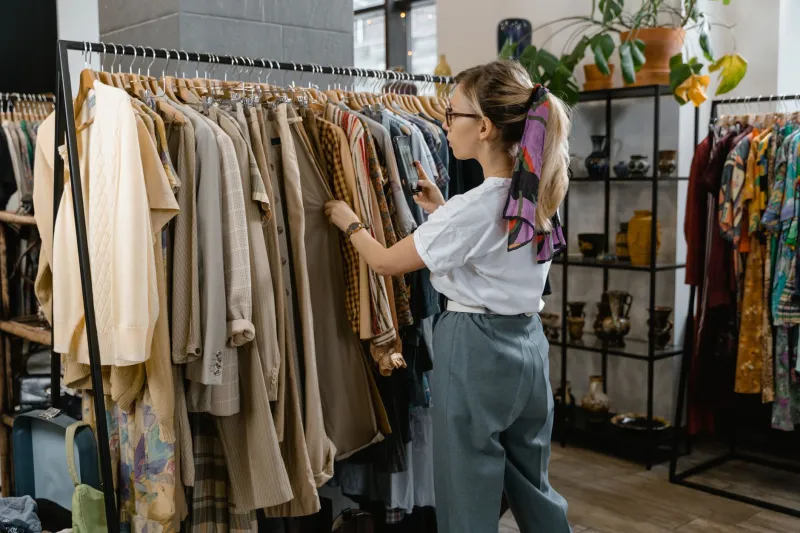
Behind Every Great Piece Is a Great Story — And Boutiques Know How to Tell It

Pull something out of your closet right now. Not your most recent online order — the other thing. The jacket you've had for four years that still gets compliments. The dress you wore to three different occasions and would wear to three more. Odds are, you remember exactly where it came from. Not just the store name, but the moment. Who was there. What they said. Why you said yes.
Now think about the last thing you ordered online at midnight after scrolling for forty-five minutes. Do you remember why you clicked Add to Cart? Probably not. And that disconnect — that gap between a piece with a story and a piece with a tracking number — explains a lot about why some clothes feel like yours and others just feel like stuff.
The Algorithm Doesn't Have Opinions. Your Boutique Does.
When you shop online, you're navigating a system designed to keep you browsing, not to help you find something meaningful. The algorithm knows your size, your price range, maybe even your color preferences. What it doesn't know is that you're trying to rebuild your wardrobe after a big life change, or that you have a trip coming up and you want to feel like yourself again, or that you've been wearing the same three things on repeat because nothing else feels right.
Your boutique, on the other hand, deals in context. A good stylist doesn't just see a customer — they see a person with a life happening around them. They remember that you mentioned hating anything too structured. They pull something off the rack not because it's trending but because it reminds them of something you said three visits ago. That kind of intuition doesn't come from a recommendation engine. It comes from paying attention.
And that attention shows up in the piece itself. When someone who knows fashion — and knows you — says "this designer made this with a specific woman in mind, and I think that woman is you," the garment stops being a product and starts being something else entirely.
Why Backstory Changes How You Wear Something
There's actual psychology behind this. Research on what's sometimes called the "biography effect" suggests that objects with known histories — even simple, mundane histories — feel more valuable to us than identical objects without one. We're wired to attach meaning to things through narrative. It's how we've always made sense of the world.
In fashion, that translates directly to your closet. When you know that a blouse was designed by someone who started their label in their apartment with twelve pieces and a dream, or that your boutique owner discovered a jewelry maker at a small market and flew home with a suitcase full of her work, those facts become part of the garment's identity. And because they're part of the garment's identity, they become part of yours when you wear it.
Compare that to knowing that your dress was one of 40,000 units manufactured for a global fast-fashion platform. It's not that the dress is worse, necessarily — it's that it carries no weight. Nothing to tell. Nothing to connect to. And items we can't connect to are items we eventually stop reaching for.
The Recommendation Story Is Part of the Product
Here's something boutique regulars understand intuitively: the moment of recommendation is part of what you're buying. When a stylist at a small shop pulls something for you and explains why — really explains it, not just "this is popular right now" but "I thought of you the second this came in" — that moment becomes inseparable from the piece itself.
You'll remember it every time you get dressed. You'll think about it when someone asks where you got it. You'll tell the story, and in telling it, you'll reinforce why you love it. That's not a small thing. That's the difference between a wardrobe full of clothes and a wardrobe full of yours.
Online shopping simply can't replicate this. Even the most thoughtfully designed e-commerce experience is missing the human in the room — the person who looked at you, considered what they know about you, and made a call. No amount of user-generated reviews or influencer content fills that gap, because none of it is about you specifically.
Provenance Makes You a Better Caretaker
There's a practical upside to all of this, too. Pieces with stories get taken care of. When you know where something came from and what it took to get it into your hands, you treat it differently. You actually read the care label. You hang it properly. You think twice before tossing it in a bag.
Fast fashion's throwaway culture isn't just a function of low prices — it's a function of low attachment. When a piece has no story, there's no emotional investment to protect. But when you bought something at a boutique where the owner told you it was made in small batches by a family-run workshop in Vermont, suddenly you're hand-washing it without being asked.
That's not guilt or obligation. That's care, and it flows naturally from connection.
Your Closet as a Collection of Chapters
The best wardrobes aren't just functional — they're biographical. Every piece in rotation tells you something about where you were, what you were going through, who helped you find it. Boutique shopping builds that kind of closet almost by default, because every transaction is embedded in a human exchange.
So the next time you reach for that jacket — the one you've had for years and still love — take a second to remember the story that came with it. Then ask yourself whether your most recent online cart can say the same thing.
If the answer is no, you already know where to go next.